Direct registration, transfer, subdivision: the steps, documents, timeframes and official costs to obtain a land title in Cameroon in 2026, and the mistakes to avoid.
In Cameroon, you can occupy a piece of land for years, pay for it, fence it, farm it, and still not be its legal owner. The law is clear: only the land title (titre foncier) proves ownership of land. According to the National Institute of Statistics, only 13.6% of households owning their home held a land title in 2014. The others remain exposed to disputes, double sales and expropriation.
This guide does not drown you in legal texts. It gives you the key guidelines: identify your situation, understand the main steps of the land title procedure in Cameroon, the timeframes, the official costs and the mistakes that cause applications to fail.
Decree No. 76/165 of 27 April 1976 defines the land title as "the official certification of real estate ownership". Once issued, it is unassailable, intangible and final, except in cases of administrative error or nullity provided by law. A receipt, an allocation letter or a private agreement does not make you an owner.
Which procedure for your land? Start with the right diagnosis
The first and most expensive mistake is starting the wrong procedure. Everything depends on the legal status of your land. In Cameroon, land belongs to three domains: the public domain, the private domain (of the State or of individuals) and the national domain, which covers most unregistered land. There are three possible cases:
This guide mainly covers case 1, the most common way for families and individuals to obtain a land title. Case 3 is summarised further down.
Who can apply for a land title in Cameroon?
For occupied or farmed national domain land, article 9 of Decree No. 76/165 opens the procedure to customary communities, their members and any Cameroonian national, provided the occupation or use predates 5 August 1974, the date the land tenure ordinance was published. More recent development remains admissible if the advisory board establishes that it was preceded by occupation before that date.
- Foreign nationals cannot obtain a title through direct registration. They can, however, buy already titled land: the notarial deed must then receive the visa of the Minister of State Property.
- Heirs: the administrator of an estate cannot obtain a land title in his own name on the estate's property (article 10). The title must reflect the heirs' rights.
Is there a minimum age to hold a land title?
No. Article 36 of the decree expressly provides that a land title can be issued in the name of a minor, with the minor's age stated on the title. The procedure is carried out by the legal representative (parent or guardian). It is a common way to secure land for a child.
Land title procedure: the 7 steps of direct registration
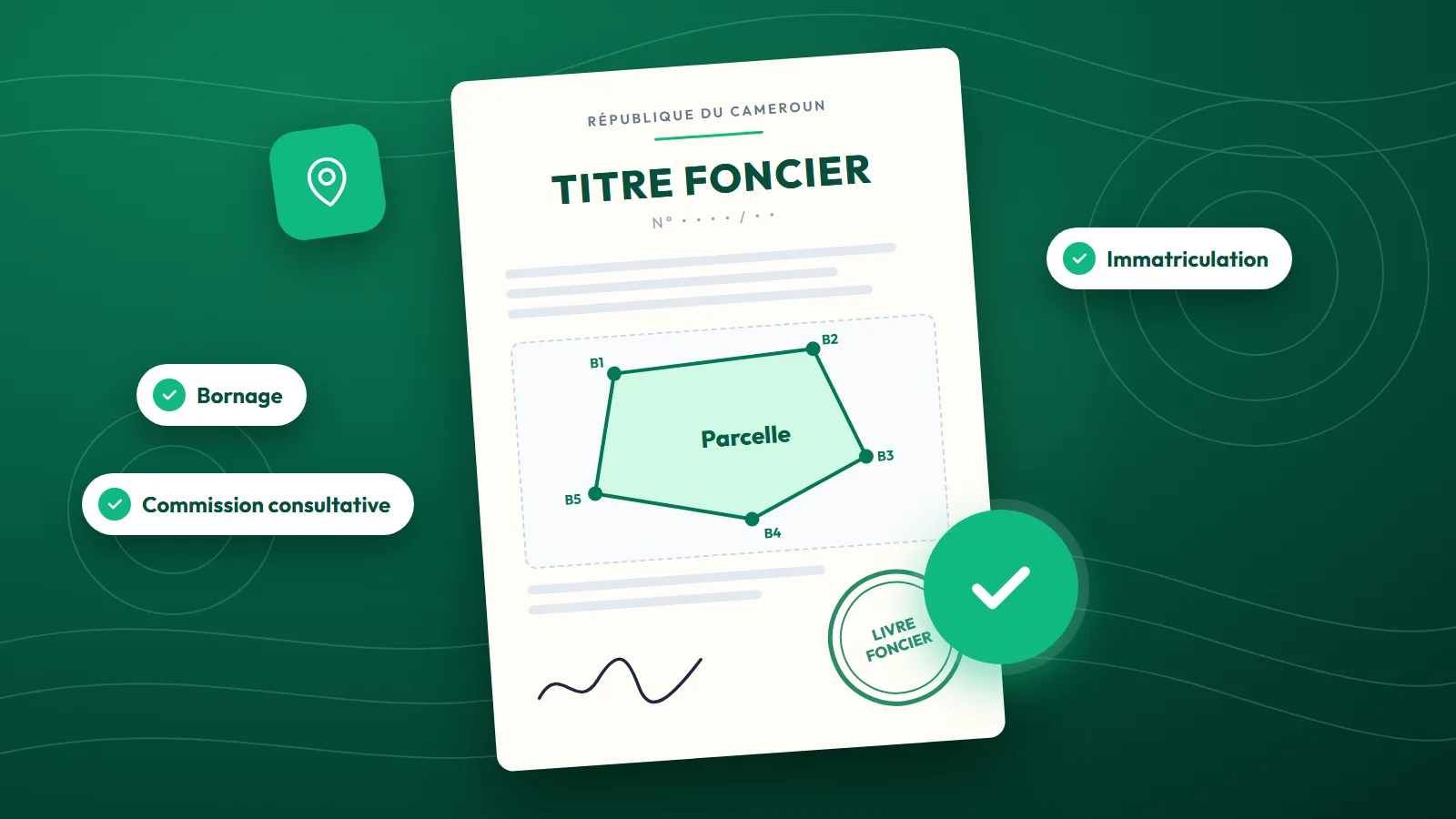
Here is the official path, as set by Decree No. 76/165 amended by Decree No. 2005/481 of 16 December 2005. The infographic below sums it up at a glance.

Step 1: Build the application file
Contrary to popular belief, the law does not impose a single pre-printed land title application form: it sets the mandatory content of the application (article 11). Your file includes:
- an application in four copies, the original being stamped, stating your full name, parentage, address, occupation, marital regime, nationality and the name under which the land is to be registered;
- a description of the land: location, area, type of occupation or use, estimated value and any charges on it.
Careful: one application can only cover one single plot. If a road or a river crosses your land, you need as many applications as there are separate plots.
Through several circular letters, the Ministry of State Property (MINDCAF) has increased the involvement of traditional chiefs. Certificates signed by the chiefdom (peaceful occupation or enjoyment, land use findings) become a prerequisite for direct registration, and a letter of no objection from first- and second-class chiefs is required for applications covering 20 hectares or more (circular of 2 April 2025). These rules are evolving and their application varies locally: have the current requirements checked in your subdivision before filing.
Step 2: File at the sub-prefecture
The file is lodged with the sub-prefect (or district head) where the land is located. He must issue a receipt within 72 hours, without any prior formality on site, then forward the file within 8 days to the divisional Land Affairs office. Keep this receipt safe: it marks the start of your procedure.
Step 3: Public notice of the application
Within 15 days, an extract of your application is posted at the land affairs office, the sub-prefecture, the council and the village chiefdom. This notice allows any challengers to come forward. The sub-prefect then sets, by decision, the date of the site visit.
Step 4: The advisory board's findings and the boundary survey
This is the key step. The advisory board, chaired by the sub-prefect, visits the land. It includes representatives of the state property and survey services, of town planning for urban land, as well as the village chief and two notables. It alone has the power to record the occupation or use of the land.
If the land use is confirmed, a sworn land surveyor immediately marks the boundaries, in the presence of the neighbours. Survey costs are paid by the applicant. A plan and a boundary report are drawn up, the report being signed by the surveyor, the board chairman, the head of the land affairs office, the village chief and the neighbours.
On pain of nullity, no registration survey may be carried out by the surveyor alone (article 13). Beware of anyone offering a "quick survey" without the board: your file would be rejected.
Step 5: Transfer to the regional level and survey closing notice
Within 30 days of the board meeting, the complete file (board report, five copies of the plan, boundary report) goes to the regional delegation. The regional land affairs service records it, checks it and, if approved, publishes a survey closing notice in the state property and land bulletin. A file that is not approved goes back to the division to be corrected, costing precious weeks.
Step 6: The objection period
Until 30 days after the notice is published, anyone concerned can lodge an objection (only if they contest who developed the land or the extent of the development) or a request to register a right. The land registrar notifies you of the objections, and you have 30 days to obtain a release, accept them or state your refusal. Objections that are not lifted are settled by the regional governor, with possible appeal to the minister and then the administrative courts.
Step 7: Entry in the Land Register and issue of the title
If there is no objection, or once they are lifted, the land registrar records your land in the Land Register and draws up the land title. You receive a duplicate: a single, personal copy, signed and stamped by the registrar. When several people jointly own the land, the duplicate is given to the first person listed, the others being able to obtain certified copies.
What does a land title look like?
An authentic land title must include (article 35):
- a description of the land: nature, area, location, boundaries and adjoining properties;
- the owner's civil status;
- the real rights and charges on the land (mortgages, easements…);
- a serial number and a specific name;
- the plan of the land, signed by a sworn surveyor and approved by the divisional head of the survey service.
A document missing any of these elements should immediately raise your suspicions.
How long does it take and how much does a land title cost?
Timeframes
Adding up the legal deadlines alone (receipt, transfer, public notice, regional transfer, objections) already takes two to three months, not counting the time needed to organise the board and the survey. In practice, direct registration takes several months, often more than a year when the file is incomplete, an objection is lodged or the services need chasing. Close follow-up of the file makes all the difference.
Official costs
The MINDCAF Manual of land procedures (2014) publishes an official schedule of fees for survey work (boundary marking, subdivision, transfer). For urban land of 1 to 5,000 sqm, it provides for:
| Cost item | Indicative amount |
|---|---|
| Tax stamp on the application | 1,000 FCFA |
| Survey fees statement | 25,000 FCFA + 2,500 FCFA (10%) |
| Printing fees | 1,500 to 3,000 FCFA |
| Tax stamps (office work) | 10,000 to 20,000 FCFA |
| Plan drawing | 5,000 to 30,000 FCFA |
| Land fee | Set by the land registrar's payment order |
These amounts do not cover the transport of survey teams, the supply and setting of boundary markers, site clearing or any support fees. These items, and the back-and-forth between offices, are what drive up the real bill. As the schedule dates from 2014, always have current rates confirmed by the relevant services.
💡 Rather skip months of procedure? Buy land that is already titled: our titled and verified plots are ready for transfer at the notary's office.
Buying already titled land: transfer and subdivision
If the land already has a title, the goal is no longer to register it but to transfer the title to your name. Two cases: a full transfer, when you buy the whole plot, and a subdivision, when you buy only part of it (a lot). In both cases, the sale must go through a notary, who then sends the land registrar a stamped application, the plan approved by the survey service, the notarial deed and a copy of the original title (article 23).
| Step | Indicative time |
|---|---|
| Certificate of ownership (status of the title) | 2 days |
| Town planning and accessibility certificates | 15 days |
| Signing the deed of sale at the notary's | 2 days |
| Registration of the deed | 15 days |
| Transfer or issue of the new title | 3 days |
According to the MINDCAF procedures manual, allow about 37 days for a full transfer and 40 days for a subdivision, excluding survey work. When a buyer or seller is a foreign national, a ministerial visa step is added (about 42 days in total). These theoretical timeframes are often exceeded in practice. For the full list of documents, read our guide: how to buy land in Cameroon, documents and step-by-step procedure.
How to check a land title (and can you do it online?)
Before buying, or to check a title you are shown, the verification is done at the land registry where the land is located. The registrar can issue a certificate of ownership, a certificate confirming the duplicate is genuine, or a certificate stating that no entry (mortgage, seizure…) encumbers the title (article 41).
Many people search for how to check a land title online in Cameroon. To our knowledge, there is not yet an official public platform to consult a land title on the Internet, despite projects to digitise land records. Beware of middlemen who claim to do it in a few clicks. We explain the reliable method in our article: how to check the authenticity of a land title in Cameroon.
Despite being final, a land title is null and void when several titles have been issued on the same land, when it was issued without following the required procedure, or when it encroaches on the public domain or the State's private domain (article 2). The minister can also withdraw a title issued following an administrative error. Hence the importance of a flawless procedure from the start.
The land title laws you should know
- Ordinance No. 74-1 of 6 July 1974 establishing land tenure rules: the foundation of Cameroonian land law.
- Decree No. 76/165 of 27 April 1976 setting the conditions for obtaining a land title, amended and supplemented by Decree No. 2005/481 of 16 December 2005: the procedure described in this guide.
- Decree No. 76/166 of 27 April 1976 on the management of the national domain: composition and role of the advisory board.
- Law No. 80/22 of 14 July 1980 on the punishment of infringements of land and state property.
- The MINDCAF Manual of land, state property and survey procedures (2014): timeframes and costs of each procedure.
- The 2025-2026 MINDCAF circular letters on the involvement of traditional chiefdoms.
Mistakes that block a land title application
- Starting the wrong procedure: requesting direct registration on free land, which falls under a concession.
- One application for several plots, or a plot cut by a road or a river.
- An incomplete file: missing details, no tax stamp, vague land description.
- An irregular survey, carried out without the board or without the neighbours.
- Missing the deadlines to respond to objections (30 days).
- Unresolved family disputes before filing, especially in inheritance cases.
- Using unauthorised middlemen who promise a title "in a few weeks".
Why entrust your file to Foncier Cameroun?
The land title procedure involves the sub-prefecture, the divisional delegation, the advisory board, a sworn surveyor, the regional delegation and then the land registry. Each link can delay your file by months. Our role: move it forward on your behalf, fully within the law.
Discover our dedicated service: land registration and land title application.